@barry
Forum Replies Created
-
AuthorPosts
-
 BarryKeymaster
D5 is where you need to put the 1N4001. It is just a circuit protection diode and not critical to the build. Technically this should be 1N5817 however the 1N4001 will still complete the circuit. R10 is a typo that I will correct.
The Microamp was created by MXR from the Dist+ minus a few parts. Since the majority of people build a Dist+, or DOD250 that is the way the PCB is designed. To provide for those wishing to build a Microamp they can still do so using the same PCB. Brent covered this above.
Also
1k63 is a 1uF
.1j63 is a 100n
4u7 and 4.7uF are the same.
Finally since 4.7uF is an electrolytic capacitor it requires the correct orientation in C4 which is designed for a square film capacitor for Dist+ and DOD250 builds. Since you are copying the MicroAmp you must use a 4.7uF electrolytic instead.
All you need to do is make sure the (+) lead of the Electrolytic gets soldered to the TOP C4 pad (looking straight on). and the Negative lead goes to the bottom pad.
BarryKeymasterThe Afterblaster pairs nicely with the Emexar.
Thanks for sharing!
August 30, 2024 at 3:04 pm in reply to: Just finished my NostalgiTone DSOTM aka the “Gilmour Special”! #33157BarryKeymasterExcellent! Thanks for sharing.
I am glad you like it.
BarryKeymasterExcellent build and thanks for posting.
There’s plenty of potential for extra heavy tones when you use Distortion and Fuzz together, or pair the Boost with either one. Just remember to adjust the Distortion or Sustain levels accordingly using proper “Gain Mapping” techniques.
For an even heavier sound, which this beast is fully capable of, try tuning all strings down to D standard, C# (like Sabbath), C, or even lower. When tuning lower than D standard, most players will need to increase the gauge of their guitar strings—unless you’re Tony Iommi, of course.
BarryKeymasterGood point Billy. I missed that.
Two of the transistors are indeed Russian so you need to put the transistor leads in the correct slots.
Look up the datasheet for your Russian transistors and verify the lead and place in the circuit accordingly.
On Russian datasheets:
K = Collector,
= EmitterBarryKeymasterIs this typical for the circuit or am I having some issues here?
No it’s not typical. My simple rule is that I do not release anything that might have an issue. I have had that circuit in circulation since 2010 so if it had issues it would be noted in the forum.
I always suggest testing each circuit of a combo build on its own first.
What is your voltage at the 9v pad of the PUTB?
List your voltages at Pin 5 and Pin 8 o f the IC.
I cannot see what exactly is happening here.
Hopefully the power jack lugs are not touching the enclosure.
BarryKeymasterThis is the exact kind of scenario where an Audio Probe will help you discover the problem area.
All I can do from my end is visually inspect your project which usually works, but not always.
BarryKeymasterExcellent build and thanks for sharing.
When using the Fuzz, also consider pairing it with the Overdrive section for another powerful combination. You can fine-tune the Bass content and adjust the voltage to achieve anything from a smoother Fuzz to a more aggressive tone—or find a balance that suits your taste.
BarryKeymasterSlightly less subtle than the Amazon logo:
It looks as though you scraped, or dremeled the mirror coating to allow light to shine through. I don’t recall seeing that before.
August 15, 2024 at 3:23 pm in reply to: Input clipping on EA Tremelo and Add-Verb combo build #33056BarryKeymaster“I guess this doesn’t help with troubleshooting.”
Not giving up yet, but the lack of headroom is clearly an issue based on your report.
The only change we made was to the Input Buffer Stage Gain: The original stock setting was R3 200k/R2 27k, giving a gain of 7.4. We modified it to R3 200k/R2 100k, resulting in a Gain of 2.
While a Gain of 2 should be fine with hot pickups, you’ve indicated that you’re out of available volume headroom and still experiencing clipping with one guitar. That’s a challenge.
As a result of your findings I suggest replacing R2 with a 33k resistor. Then, as Billy suggested, reduce R3 to 100k as an alternate way to lower the gain, giving you a Gain of 3. This should help bring back some Volume headroom as well as bass and treble that may have been lost by reducing the overall gain.
I suspect you will still experience clipping with hotter pickups.My thought is to get a little more Gain in the Input Buffer Stage for better Volume and less apparent Bass and Treble reduction first. If you are still getting clipping then I would try replacing R7 with a 10k.
An audio probe would be helpful if you have one to verify exactly where in the circuit the clipping is occurring.
August 14, 2024 at 8:32 pm in reply to: Input clipping on EA Tremelo and Add-Verb combo build #33052BarryKeymasterI suggest buying a resistor assortment kit of common values on eBay.
Very handy if you do not have stock.
As for values required for your Tremolo I do not know yet since this is something new and I do not have a guitar with active pickups to test with myself. I will have some suggestions, but would like to get the Reverb sorted first.
BarryKeymasterThe short answer is no to the gloss layer and no to the white layer in your particular case.
There is plenty of discussion in this thread, as well as a helpful step-by-step tutorial:
https://guitarpcb.com/community/topic/just-finished-nostalgiatone-dsotm/
You can also use AI, like ChatGPT, to assist with art program-related questions. While it’s not perfect, it can be much faster at answering specific questions than sifting through a YouTube video—although that’s another alternative. I am certainly not an expert in the art department.
BarryKeymasterYou’re correct, that shouldn’t be happening.
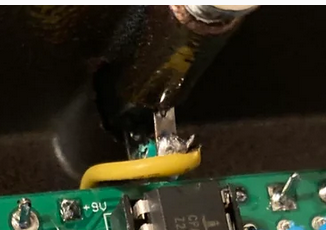
I strongly recommend doing a full re-flow, especially on the clipping diodes. Take your time, and have extra solder ready in case you need it. Be prepared to remove any excess solder as well. Keep the tip clean and tinned throughout the process.
Also, be cautious with the wires, as a few strands are showing. You may need to redo them if necessary. Make sure to route your power wires away from the audio path wiring as much as possible.
August 8, 2024 at 12:08 pm in reply to: Input clipping on EA Tremelo and Add-Verb combo build #32987BarryKeymasterI recommend replacing the 27k resistor at R2 on the Add-verb with a 100k resistor. Based on what you’ve mentioned, it seems like your pickups are hitting the first stage too hard, and R2 functions like a Preamp control. Adjusting it is similar to tweaking a gain knob on a mixing desk to better manage the input level.
This procedure should take about 5 to 10 minutes if you have a desoldering pump or desoldering braid.
BarryKeymasterBefore we dive into modifying both circuits, I want to highlight that these designs have been available for over 10 years and are widely used by other DIY communities using the exact same values. If it were a design issue, there would be an extraordinary amount of posts discussing them. I have only found one post concerning volume issues, which I suspect was also related to high-output pickups.
Wilkie’s suggestion of adding an input resistor is a gain-mapping modification and not indicative of any missing component in the actual circuit design. He frequently builds combo pedals and owns guitars with both high-output and low output pickups, so this is routine for him particularly since pickups change the gain of everything from the guitar through to the amp. (hence his reference to gain mapping)
I suggest simply replacing the 27k resistor at R2 on the Add-verb with a 100k resistor. This might be tricky if the brick is in the way, so please be careful when lifting the brick to desolder—be mindful of its solder joints. You may need to reflow the brick joints when finished.
This change can likely rectify the entire issue, although your description of the guitar volume pot and its interaction with the Add-verb circuit may indicate an entirely separate issue. However, let’s take it one step at a time.
The EA Tremolo is another widely popular circuit among the community, known for its excellent buffer, which naturally boosts the signal. High-output pickups will accentuate this effect. The simplest solution is to lower the Volume control, effectively adjusting the gain mapping, but only after fixing the Add-verb problem.
It’s recommended to build and test each circuit individually before combining them when creating combos. There are several good combo building guides on the Guides Page.
I hope this helps!
BarryKeymasterI tried to respond but accidentally deleted your post, apologies.
What I wanted to let you know is that this demo uses both the boost and compressor engaged (one after the other) and the entire circuit is not in any enclosure. While a compressor by nature can be a noise amplifier I did not have any unexpected noise. (see below)
That said, I am using humbuckers. There would have been more noise with single coil.
BarryKeymasterThat is certainly a different take! Thank you for sharing.
I have only seen that once before where the guy lined his with some weed and a skeleton.
I am not suggesting you do that but it did occur to me what some LED filament wire would look like under the hood?
-
AuthorPosts


 = Emitter