
Your Source for DIY Pedal PCBs and NostalgiTone! › GuitarPCB Forum › General DIY Pedal Discussion › Popular Clipping Options
Tagged: clipping ccrt
- This topic has 18 replies, 7 voices, and was last updated 2 weeks, 1 day ago by
 Barry.

-
AuthorPosts
-
August 22, 2026 at 4:14 pm #40382brdModerator
Hi All
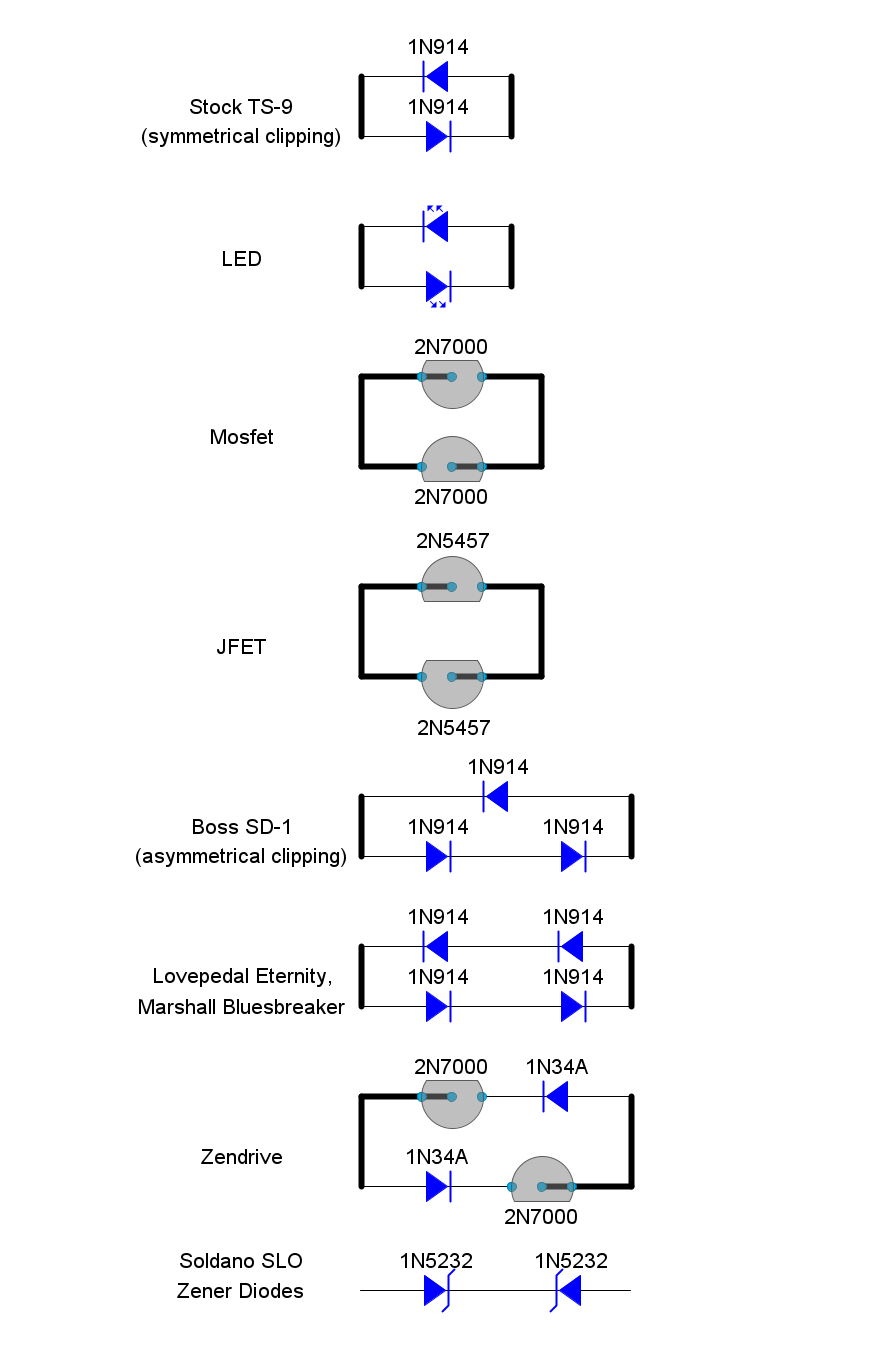
After reading Barry’s new guide: How Gain, Headroom & Clipping Shape Your Tone, I thought it might be interesting to post a few clipping recipes used in some popular pedals for a reference and as an invite for others to share their favorites. These schematics are all used in feedback (soft) clipping stages but can also be used for signal path (hard clipping). The pin outs for the Jfet and Mosfet versions are used for illustration, check your pin-outs before applying them. There are many different diodes and combinations that can be used, if you have a favorite that I haven’t listed or one that you have used to mod a pedal, please share it. Schematics optional.
I hope this helps. If I made any mistakes please let me know.
Best
BRD
August 23, 2026 at 1:32 pm #40385BarryKeymasterThis is excellent, BRD, but I was hoping this wouldn’t just be a conversation between you and I. 😄
This is one of the most advantageous areas for DIYers to explore and typically an easy modification. More importantly, when you understand what is actually going on, you can get exactly what you want instead of randomly guessing at different clipping options.
There’s a lot to discuss here, so maybe some people will jump in with some thoughts, input, questions, or curiosities and get the conversation going.
Here’s a question of my own: How much do you think the difference between the softer knee of a 1N34A and the harder knee of a 1N5817 affects the actual clipping character when substituting one for the other? Being that their forward voltages are fairly close, would you expect the difference in the way they clip to be noticeable in the sound?
August 24, 2026 at 7:08 am #40391brdModeratorI didn’t expect to break the internet with my post, but it’s here and it’s searchable, and I just hope it might help somebody someday.
My short answer is, yes, I would expect there to be a difference that would be noticeable. With that said, it’s worth noting that 1N34A’s can have considerably different curve traces. You can find some graphs done by Analog.man showing variations they have found in Klon knockoffs. There is also an excellent post on this forum here that shows in a graph how much of a difference there can be between several kinds of diodes.
There could also be other factors that affect the sonic characteristics of any component that is used for clipping and it’s perceived effect. I believed for years that Mosfets had a nice soft clip because that’s what my ears were telling me. I found out later that they actually have a very abrupt cut-off. I still like them, even though science tells me I’m not hearing what I thought I was.
August 24, 2026 at 1:26 pm #40392BarryKeymaster“I didn’t expect to break the internet with my post”
That said, as the owner of the site, I have access to information that shows me exactly how many people are stopping by and reading these posts, and I bet you would be surprised by the numbers. The biggest difference between today and 10+ years ago is that people used to take the time to comment, ask questions, and share their experiences. That’s something I really miss.
For example, this thread posted by BigO about my new guide, How Gain, Headroom & Clipping Shape Your Tone, has already had 1,543 unique visits, most of them from members here, but only two comments. Yours and mine.
While I’m certainly glad people are reading it, I’d love to see more of the discussion and interaction that used to be such a big part of the forum.
Let me look over your answer regarding the 1N34A vs. 1N5817 analysis, and I’ll post later on that.
I appreciate your post, interest, and participation.
August 25, 2026 at 11:00 pm #40406BarryKeymasterI’ve been thinking a little more about the 1N34A vs. 1N5817 comparison. The forward voltage difference between the two really isn’t all that great, which the chart and datasheets both confirm.
Looking at the I/V curves, there does appear to be a difference in both where they begin to conduct and the shape of the “knee” as they transition into conduction. What I’m really curious about is how significant those differences actually are when the diodes are being used for clipping in a pedal circuit.
The reason I am curious is because Germanium Diodes are much harder to come by and expensive while the 1N5817 is readily available and affordable.
If the 1N5817 can provide suitable clipping characteristics despite the differences in its I/V curve and knee, I think the real question is whether those differences are significant enough to make the 1N34A audibly preferable, or whether the 1N5817 would make a perfectly suitable and much more readily available replacement. And if there is an audible difference, how noticeable is it in a real-world playing situation if it requires careful A/B switching to hear in the first place?
Reference: Circuits Journal — Analysis of nonlinear distortion in diode-based clipping circuits
This study includes measurements of both 1N34A germanium and 1N5817 Schottky diodes in clipping applications and discusses differences in their knee characteristics and resulting distortion.
The most notable quote from the above article says, “Germanium diodes (1N34A) demonstrated softer knee characteristics with 0.31 V forward voltage, yielding more gradual distortion onset preferred for musical applications. Schottky devices (1N5817) provided the lowest threshold at 0.24 V with intermediate distortion characteristics.”
Again, I am just trying to get some outside opinions to see how much of an audible difference there really is and whether the 1N5817 could be used as a substitute moving forward. I have tested this on my own using my DPDT wiring board with Germanium on one side and 1N5817 on the other in a Distortion+ style circuit, but I would love to hear other opinions first before revealing my results.
I don’t think there are any right or wrong answers here, and I would also be interested to hear if I am missing any other factors that should be considered. Let me know what you think.
August 28, 2026 at 5:08 pm #40420brdModeratorThat article is a great read, It suggests that the 1N5817 Schottky diode is a compromise between hard clipping silicon and soft clipping germanium diodes. The curve traces show that the 1N5817 does have a medium knee and a low threshold, so it could work well as a substitute for a 1N34A.
Another take away that I wasn’t aware of is the stated effect of the knee on harmonic content. To quote the article “Spectral analysis revealed that soft clipping generates predominantly odd harmonics with rapid high-order rolloff, whilst hard clipping produces richer harmonic content extending to the eighth harmonic and beyond.” I had thought that the majority of guitar distortion effects produce symmetrical clipping and that they generally produced mostly second order harmonics. I also believed that softer germanium clipping just made the sound warmer or less edgy. I guess I learned something today.
Time to break out my GuitarPCB Roto-Tone Deluxe diode test rig and check this out. I wonder what some 1N5817’s will do for a Klon circuit…
August 29, 2026 at 5:45 pm #40428Big OParticipantSomething I learned more recently (within the last 2 or 3 years) is that a BAT41 diode can be somewhat like a Ge diode for clipping and potentially a substitute.
Also, you can get somewhat asymmetrical clipping using a Ge diode paired with a Si diode such as a 1N914 as they have different forward voltages.
Just a couple of things I have learned on forums and watching YouTube videos.
August 30, 2026 at 7:27 pm #40437RParticipantInteresting articles and circuitry. I bought a dozen OBN germaniums on ebay from Cal. Vf measures .25 to .31. I’m just starting a Klon clone build with sockets and shall try some of these ideas. Maybe make several bread boards to switch in to see what results.
But the voodoo board comes first 🙂
Thanks
R
August 31, 2026 at 10:42 am #40439JasonWickershamParticipantI had not considered use to the 5817 as a potential replacement for germanium diodes.. I will have to experiment on some Emexar boards I have laying about.
Barry, R, Steve: have any of you guys ever used bridge rectifier chips for clipping purposes?
I have eyeballed these guys and had questions..
GBI40M-T Diotec Semiconductor | MouserAugust 31, 2026 at 5:18 pm #40441brdModeratorBig O
I used a set of BAT41’s in one of Barry’s older Blues Buster boards which is very similar to the new NT 60’s Overdrive. I did an extensive diode shootout before deciding the BAT41’s sounded better with my rig that the usual 1N914’s or 1N4148″s. Thanks for mentioning those.
The Ge Si combo should work well, it could be very amp like, Have you tried it? I’m sure there are some more great asymmetrical clipping combos, that’s why I went fishing for ideas.
I know you have a nice collection of pedals. Do you have any favorite stock or mod clipping setups?
August 31, 2026 at 6:43 pm #40443JasonWickershamParticipantBRD, I have mostly used BAT 41 in TS style builds
I have a few 60s OD boards that need work up, and will give the BAT41 a go on them, as 4198s had been my usual in that style circuit.August 31, 2026 at 7:46 pm #40444BarryKeymaster@ Jason: I have never considered GBI40M. I will look into that.
With regards to Bat41 my personal favorite application for those was in the DumbleTone. I was pleasantly surprised by the result.
I will wait for some people to try 1N5817 in place of Germanium like 1N34A before adding anything because I don’t want to spoil the party with my interpretation. Also, imagine having 1N5817 in place of 1N914 in a Muff circuit 😉
August 31, 2026 at 8:12 pm #40445brdModeratorJason,
I recommend using some sockets. Your rig will determine what sounds good. I also added an option to switch to 3 BAT41’s for asynchronous clipping on that same pedal but never liked it in the mix.
I took a quick look at the rectifier bridge diodes you asked about. They have some extra leads to take 2 AC currents and make them DC. I may not have thought of every way you could wire them into a circuit, but the way I see it, you would need 2 of them to make a typical clipping circuit and you would end up with 4 redundant diodes. I’m not saying that is bad, you never know what kind of mojo is hiding behind the science.
September 1, 2026 at 7:49 am #40447JasonWickershamParticipant@BRD I have read the data sheet on those devices, and came to similar conclusions.. It has been more of a thought experiment on my end, “What interesting could be accomplished with these parts?”
IIRC, I have seen some passive ring modulator-ish type designs with these, but that has been about it.
None the less, might be a fun avenue to explore.
@Barry, you know, I believe I just happen to have a spare Harbinger board for such an application.September 9, 2026 at 2:18 pm #40489Byrdhouse CompressorParticipantI really hope this is a teaser for an NT transistor Big Muff circuit.
I’ve also got some BAT41 and BAT46 diodes I’m going to try with the EMEXAR – I really love being as close to the original as possible, but at 2.50 per 1n34a plus shipping from the sites I’ve seen, I think I’ll limit it to one “authentic” board.
September 26, 2026 at 12:25 am #40645MattParticipantThis is great. Thank you.
Many years ago I made a giant Rat circuit and used two rototones for a total of nine clipping options. I still use MegaRat as a test reference for all those options. My favorite in the Rat was the BAT41.
September 29, 2026 at 8:50 pm #40715 -
AuthorPosts



- You must be logged in to reply to this topic.